
What Does Research Say About Pottery And Clay Therapy For Specially Abled Children?
Ceramic art therapy for children with autism is a type of therapy for expressive arts which uses activities that involve clay. For example, hand-building, wheel throwing, coiling and sculpting as an instrument for providing mental guidance and support for development. Contrary to conventional talk-based therapies, they provide a tactile and non-verbal channel that children who have Autism Spectrum Disorder (ASD) can express their emotions or practice focus and socialise with no pressure of communicating directly.
In the larger area of art therapy, clay art therapy is intended to enhance and not substitute for the traditional therapies. Particularly, it is admired due to its compatibility with the cognitive and sensory characteristics of children with autism. It is a hands on process of working with clay that helps to develop mindfulness, patience, and motor coordination. The group sessions of pottery create chances for social interaction as well as friendship among peers.
In CNS Spectrums (Cambridge University Press 2023), the study looked at the effects of ceramic art therapy for 58 specially abled children. Utilising the rating scale of SSIS-RS, researchers discovered that children who received ceramic-integrated group therapy showed improved communication, social skills and reduced problem behaviour compared with the control group who received only routine interventions, which supports the use of ceramic art therapy as an effective non-pharmacological treatment to treat ASD.
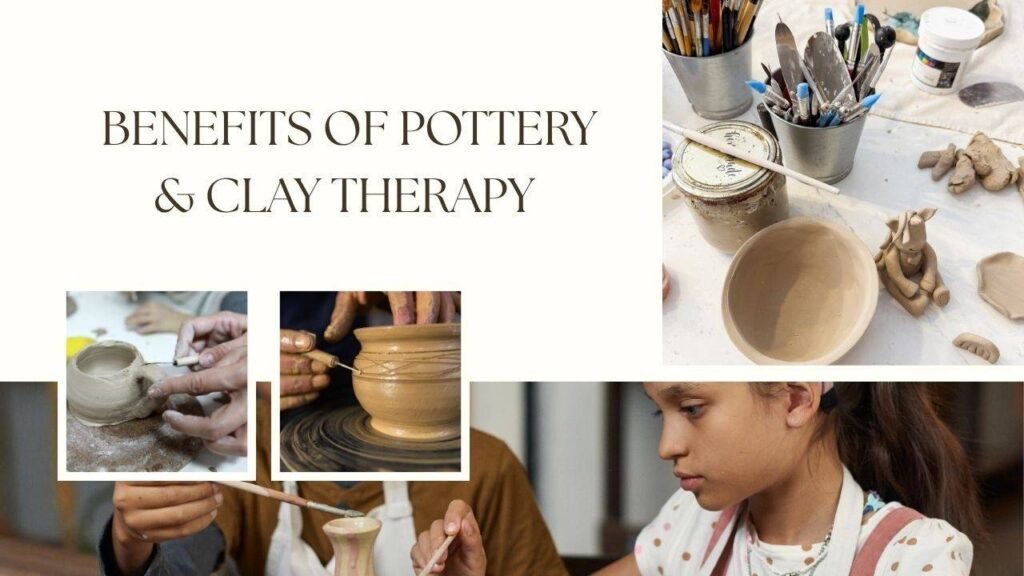
What Is Ceramic Art Therapy For Children With Autism?
Ceramic art therapy for children who have Autism is a recognised clinically non-pharmacological therapy that utilises hands-on experiences of working with clay by hand-building, making sculptures, coils or pinching and wheel throwing to facilitate therapeutic processes to help in the psychological, emotional, and social development of children with the diagnosis of Autism Spectrum Disorder (ASD).
Why Clay?
Children who are autistic often struggle with communication through words and social interaction. Clay is a powerful medium that responds to contact, doesn’t require words and rewards the ability to focus and perseverance. If a child presses, rolls or creates with clay, they’re not only creating artwork. These are:
- Reducing emotions by repetitive movement
- Training focus and concentration by paying attention to an activity
- Communication non-verbally by creating
- Experiencing cause and effect as their actions shape the material
- Achieving confidence through the joy of the finished product
How effective are art based therapies for children with autism?
A peer-reviewed scoping analysis released in the OTJR: Occupational Therapy Journal of Research (PMC/PubMed 2022) reviewed 15 top-quality research studies and discovered that the creative arts therapies — such as music, drawing, and theatre — significantly improved the social interactions and body performance for children suffering from Autism spectrum disorders. These findings offer solid evidence of occupational therapy proving that the arts are not simply enrichment but can be used as a treatment.
Useful link: Art therapy for children
How Does Pottery Help Specially Abled Children Develop Social Skills?
Pottery is a great way for children who are especially gifted to build the social skills that the traditional school or clinic setting usually does not provide. The way to do this is
1. It Creates Natural Opportunities For Interaction
As children engage at the pottery table, their interactions with each other occur naturally. The children watch one another work as they ask questions, play with tools, and then comment on the work of others -but without the rigid pattern of a scripted practice. For children with disabilities like autism, ADHD, and developmental difficulties, this non-pressured group environment can be far superior to directly educating children on social skills.
2. It Removes The Pressure Of Verbal Communication
A lot of children with special needs have difficulty speaking and face-to–face interaction. Clay provides a different way of communicating. The child who is unable to communicate “I feel happy” can express it by what they make. This bridge, which is non-verbal, gradually develops the confidence required for interactions with others, which makes pottery an incredibly accessible way to connect with peers.
3. It Builds Confidence Through Achievement
The process of creating a pottery piece, no matter how small, provides the child with something tangible that they can be satisfied with. For children with disabilities who are frequently frustrated within social or academic settings, the feeling of success can be transformative. A sense of confidence built from the potter’s table is naturally carried through to social interactions that occur outside of it.
4. It Encourages Empathy And Peer Awareness
At group pottery classes, children observe one another’s challenges and achievements. They develop an appreciation for various approaches. Assist when a piece of pottery breaks down or becomes cracked. The small moments help develop empathy, one of the most important but difficult social skills needed by children who have ASD or other disorders of development.
What Types Of Specially Abled Children Benefit From Clay Therapy?
Its sensory, tactile and non-verbal characteristics make it among the most accessible therapeutic methods that are available to children with a wide variety of neurological, developmental, and psychological conditions. Studies and clinical experience consistently reveal that children who have difficulty in conventional therapy environments typically thrive when clay is placed in their hands.
This is an in-depth analysis of which children are most benefited.
Children With Autism Spectrum Disorder (ASD)
In all the cases where clay therapy has been researched, autism spectrum disorder is the most pronounced and has the best scientifically based research support. Children who have ASD generally face challenges across three different areas: interpersonal communication and repetitive behaviour, and processing of sensory information. Clay can address all three of these simultaneously. The physical interaction in clay is a great way to satisfy your sensory behaviours constructively, and group sessions with pottery offer natural opportunities to socialise that social skills classes often fail to recreate.
Children With ADHD
Children who have Attention Deficit Hyperactivity Disorder have a difficult time maintaining concentration, impulse control, and sitting for long enough to be able to take advantage of traditional therapy or educational programs. Clay therapy provides a unique experience suitable for the ADHD persona. It is active, as well as sensory and stimulating.
The act of physically pushing, rolling, pinching, and building with clay channels restless energy productively. Contrary to tasks that require focus, the process of making pottery requires complete physical participation and keeps hands, eyes, and brain active simultaneously. The ADHD brain requires multi-sensory involvement in order to be able to stay focused.
Children With Down Syndrome
Children who have Down syndrome experience a combination of intellectual disabilities along with gross and fine motor difficulties in speech and language, as well as differences in social development. Clay therapy tackles all these aspects at once, which makes it an especially comprehensive treatment for this group.
Clay directly stimulates the fingers, hands and wrists, thereby enhancing the fine motor skills which children who have Down Syndrome often need additional help to achieve. The rolling coils, pinching pots, and smoothing the areas are all gentle resistance exercises disguised as play with creativity. In time, these exercises increase grip strength, hand-eye coordination, as well as the use of both hands’ abilities that directly assist in writing, eating and other day-to-day activities.
What Do Experts Say About Clay And Pottery As Therapy For Children?
Alice Darlington -- Autism Art Coordinator And Advocate
There are a few voices that are able to carry the weight of expert knowledge and personal knowledge quite as well as Alice Darlington, the art teacher who’s dedicated her time to providing ceramic arts classes specially designed for children who have autism.
Darlington’s path to therapy with pottery was a deeply personal experience. What she observed in the pottery studio — a sense of focus as well as a calm sensation of presence formed the basis for her involvement with children who are autistic.
After observing the effects on her classes across a variety of people, Darlington describes the effect of ceramics on autistic kids in a way that is revealing. According to her, pottery arts sessions greatly increase confidence in participants and open up social networks by implementing the principles behind floor-time play therapy. It is noted that since the majority of children had no previous exposure to art, pottery can spark a feeling of curiosity. Children start asking questions, being involved with the environment, as well as interacting with their peers through ways that their parents, as well as therapists, have never experienced previously.
Blake Zucker
Blake Zucker gives some of the most intriguing perspectives on the use of pottery in therapy – the perspective of a professional artist who happens to be an autistic person. His thoughts on what the word “clay” signifies to him reveal how it can be so beneficial with autistic kids.
Zucker describes his work at the wheel as a moment that enthrals all of his body. The action of spinning the wheel, he says, has a soothing characteristic — its rhythm creates a tranquil atmosphere that soothes the rumblings of the external world. The process of pulling clay upward is what he calls control and creativity energy, which gives him the sensation of complete freedom, which is a feeling of independence that a large number of autistic persons seldom experience in their daily working or social situations.
Conclusion: What the Research Tells Us About Pottery And Clay Therapy For Specially Abled Children
This page was started with the question: What is the research saying regarding clay and pottery therapy specifically for children with disabilities? After examining the research and expert opinions, as well as the clinical frameworks and real-life experience of families and children, the answer is now clear.
Research shows that it is effective. Pottery and Clay therapy is effective.
This is not intended as a cure-all. It is not a substitute for conventional medical treatments. However, it is an effective and scientifically backed complement to treatment that can aid children with disabilities.
References / Citations Section
- Henley (2018) — Art therapy and autism
- Chen, E. & Shi, F. (2023). CNS Spectrums, Cambridge University Press
