
Julphar Pottery: Uncovering The UAE's Most Ancient Ceramic Tradition
Over the past 700 years, Ras al-Khaimah was home to a ceramics manufacturing facility, which was the most important pre-oil manufacturing industry in the region of the earlier United Arab Emirates. Pottery production began with the development of the city of Julfar and spread throughout the northern region of Ras Al Khaimah . In the beginning, the potters worked in Ghailan, and later in Shimal and Wadi Haqil as well. Here, there are still the remnants of kilns for pottery. The last clay maker passed away around twenty years ago. Today, only his son and a few family members have some knowledge of the production process and the techniques.
The pottery from Ras al Khaimah known as Julphar ware, was widely used throughout the UAE. It also had extensive distribution in the western Indian Ocean. It can be seen on the southern shores of Iran, throughout Bahrain and Qatar, in the Eastern Province of Saudi Arabia, in Oman, in Yemen, and along the eastern coast of Africa.
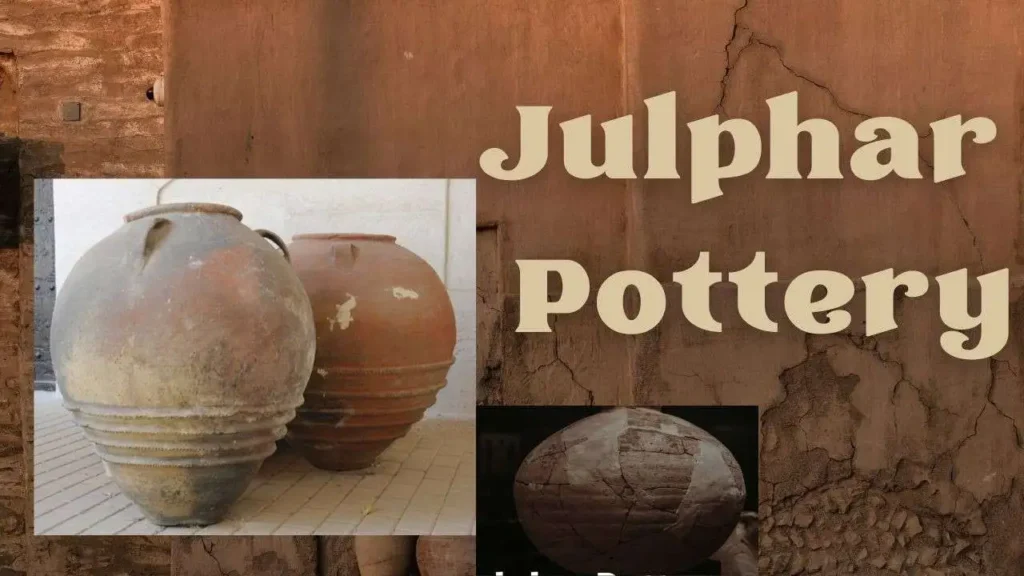
What Is Julphar Pottery?
Julphar pottery also known as Julfar ware, is the most traditional clayware produced in the Ras Al Khaimah region of the UAE. The name comes from Julfar, the old trade port that once thrived in the present region of Rak.
The pottery is described as non glazed earthenware. Julfar ware was made from a distinct mixture of mountain red clay and green underground clay from throughout the Ras Al Khaimah region. Its simple design is its forte. Made for daily use in the desert’s harsh environment, the ceramic proved durable, functional, and crafted with exceptional skill.
Observations From Ras Al Khaimah’s Pottery Culture
When visiting pottery workshops and the heritage zones of Ras Al Khaimah, many visitors are surprised by how contemporary clay art is linked to the traditional clay of the emirate’s heritage. The clay’s earthy textures, formed by hand, and the easy finishing techniques found in local studios reflect the influence of historical pottery.
What Makes Julfar A Key Historical Landmark In The Region?
Julfar is located approximately 6 kilometers north of the modern Ras Al Khaimah city. Julfar was once among the largest trade ports of the Arabian Gulf region. Traders from the Gulf, Persia, India, and East Africa exchanged goods through ports, including spices, textiles, pearls, and pottery.
The pottery kilns in the area provided traders with locally produced goods. Julfar ware soon became a characteristic of Indian Ocean trade routes, spreading as far west as the East African coast and as far east as the Indian subcontinent.
The Kiln Sites: Ghaylan, Shimal, And Wadi Haqil
Pottery production in Ras Al Khaimah was concentrated in several kilns, each representing a distinct period in the history. The archaeological study, which includes the renowned 2013 study conducted by Gen Mitsuishi and Derek Kennet, published in the Proceedings of the Seminar for Arabian Studies, has discovered four key Kiln sites.
1. Ghaylan
Ghaylan is believed to be one of the first kiln sites with a variety of pottery production. The widest range of vessels was produced there, indicating an exploratory and broad stage of the beginning of the development of this industry.
2. Shimal
When production increased, the kilns of Shimal showed greater uniformity and a shift towards more uniform pottery types, which could be a result of increased demand from trade networks.
3. North Shimal Tower
The kiln site, close to the North Shimal Tower, marks an additional phase in the evolution of Julfar ware and forms part of the wider Shimal manufacturing cluster.
4. Wadi Haqil
One of the most modern and important kiln sites, Wadi Haqil, was the most recent active production center of Julfar ware. About 20 kilns remain in the Wadi (valley) today, making it an active archaeological site. This was where the final Julfar potters were employed, and where they stopped production soon after the Second World War.
How Was Julphar Pottery Made? Traditional Techniques Explained
Making Julfar ware was a complex, multi-stage procedure that demanded extensive knowledge of local resources, refined physical skills, and a thorough understanding of firing. The beginning of 2013 was when Mohammed Hamer — son of the most famous Julphar pottery maker — showed the ancient techniques, providing the researchers with an unusual live record of the art.
Clay Collection And Preparation
Potters gathered various types of clay at different places throughout Ras Al Khaimah — for example, red clay from the Hajar Mountains, and green clay from underground deposits. The clays were mixed to achieve a perfect consistency. Blending was accomplished by pummelling the clays with large sticks until they were polished and smooth. Then they began filtering the mix to remove stones and other unwanted particles. Clay was moistened by soaking in water until it reached an ideal state of workability, as the Julfar ceramics referred to it, by working with Tinn (the Arabic word for clay).
Forming The Vessel
The artist worked on the wheel of a primitive model, starting with a clay base. Instead of throwing the entire vessel at once, the conventional Julfar method involved forming clay coils—long ropes of clay that were gradually added to the base, creating the vessel’s walls layer by layer. The inside and outside of the coils were smoothed using a shell. This could be used as both a practical tool and a distinct feature of the Julfar technique.
Drying And Firing
When the vessel was formed, it was dried before being placed in the firing kiln. The kilns found at places such as Wadi Haqil had updrafts – basic earthen structures from which the heat escaped from beneath the ceramic. The firing process transformed the clay into durable earthenware, giving the red-brown-red body the typical warmth of Julfar ware.
What Did Julphar Potters Make? Types Of Vessels
The pottery makers of Shimal, as well as Wadi Haqil, produced a wide and useful range of ceramic vessels. These include:
- Cups and small bowls for drinking and eating.
- Pots to cook meals on open fires
- Water pots (barma) to store as well as cool drinking water
- Large storage jars for grain, dates, and other provisions
The ceramics were primarily functional; their form driven by function rather than decoration. The vessels were robust, rounded, and simple. Perfect for the demands of life in the desert and maritime trade. The lack of glaze was distinctive: Julfar ware was fired at temperatures that produced porous earthenware, perfect for keeping water cool during evaporation.
The End Of An Era: Why Julphar Pottery Ceased
The story of the traditional UAE pottery is an ultimate tale of loss. Production in the emirate stopped just after the Second World War. Two factors combined to render the old pottery industry unable to survive: First, the flood of imported ceramics and products that could be made more cheaply; second, the development of plastic goods that could substitute for traditional ceramics used in homes in a matter of minutes.
The final Julfar pottery maker—Mohammed Hamer’s father — passed away about two decades ago. He passed through the middle of the 1990s. When he passed away, the knowledge of the art was almost gone. Son and relatives living today are left with only a fragment of the initial process’s knowledge. No active production processes for making traditional Julfar ware continue today.
Today, preserving the remaining knowledge of Julphar pottery has become increasingly important.
Revival Efforts: Keeping The Julfar Tradition Alive
A growing group of artists, scholars, and heritage groups is working to preserve and promote Julphar Pottery’s heritage.
Ruth Impey And The Tinn Project
The British-born ceramicist and NYU Abu Dhabi FIND Fellow, Ruth Impey, dedicated years of study to examining Julfar ware and attempting to revive its methods. While accumulating over three tons of clay sourced from the Hajar Mountains, she worked with Mohammed Hamer to reconstruct traditional production methods. She designed an experimental kiln called “Updraft One” and created the first pottery made from local UAE clay over the course of 60 years. Her initiative, Tinn, was designed to bring contemporary UAE people and their clay tradition together.
National Museum Of Ras Al Khaimah
Visitors to the National museum of Ras Al Khaimah can see Julfar ware pottery on display. The museum displays its pottery within the context of Ras Khaimah’s wider heritage, linking it to the archaeological sites.
Ras Al Khaimah Heritage Sites
It is believed that the RAK Department of Antiquities and Museums, as well as the Ras Al Khaimah tourism authority, have both declared Julphar Pottery a key heritage attraction. Kilns that are still in use at Wadi Haqil are a must see site of archeological significance, and the art of pottery making is promoted as a component of the cultural attractions.
Frequently Asked Questions About Traditional UAE Pottery
1. Where can I see ancient clay craft today?
Original pieces are on exhibit at the National Museum of Ras Al Khaimah.
2. Why did Julphar Pottery production stop?
The traditional production of Julfar Ware ceased shortly after the Second World War, when the import of ceramics and the mass production of plastics rendered the old-fashioned industry of pottery economically unsustainable. The last pottery maker using traditional Julfar methods passed away in the mid 1990s. His son and family members, with only a few clues about the original methods.
3. What is the place where Julphar Pottery originated?
The Julphar Pottery was founded in the early trading city of Julfar, located within what is today Ras Al Khaimah. It was produced at the kilns situated in Ghaylan, Shamal and Wadi Hail. The remnants of around 20 kilns are still visible today.
4. When was Julphar pottery first made?
Archaeological evidence suggests that Julfar ware was produced from the 14th century through the mid 20th century for more than 700 years. Production peaked during the 15th and 16th centuries. Production stopped shortly after the Second World War.
Connecting Heritage With Modern Creativity
Presently, Creative Hands Pottery Studio is a place where visitors can experience the art of pottery making. In the hands-on process, visitors will experience the pottery while expressing their creativity in a modern environment. The clay studio setting allows observation of the art that underlies pottery and encourages individual creative thinking. Through hands on activities, such as hand building in pottery, pottery on the wheel, or pottery painting, guests can experience an exciting connection to one of the traditional artistic practices of the United Arab Emirates.
Conclusion: A Ceramic Legacy Written In Clay
Julphar pottery is an important emblem of the rich heritage, reflecting the skills and daily activities of the early community. The practical design and sturdy construction made it the ideal choice for storage and even survival, highlighting its importance in Ras Al Khaimah’s history. Julphar pottery represents a tradition of art which continues to encourage an appreciation of traditional practices.
You may also like to read, how to join a beginner pottery workshop in UAE
