
Difference Between Hand Building And Wheel Throwing
Pottery has a range of creative techniques that include hand building and wheel throwing, among the two most well known ways to create. Although both require shaping clay into decorative items, they vary in terms of the technique used.
Here at Creative hands pottery studio, one of the biggest concerns we get from beginners is whether they should begin by hand building or with wheel throwing. Both methods of making pottery are exciting, yet they give distinct experiences. Hand building lets you create clay using your fingers and a simple tool. Wheel throwing utilizes the pottery wheel for uniform pottery pieces.
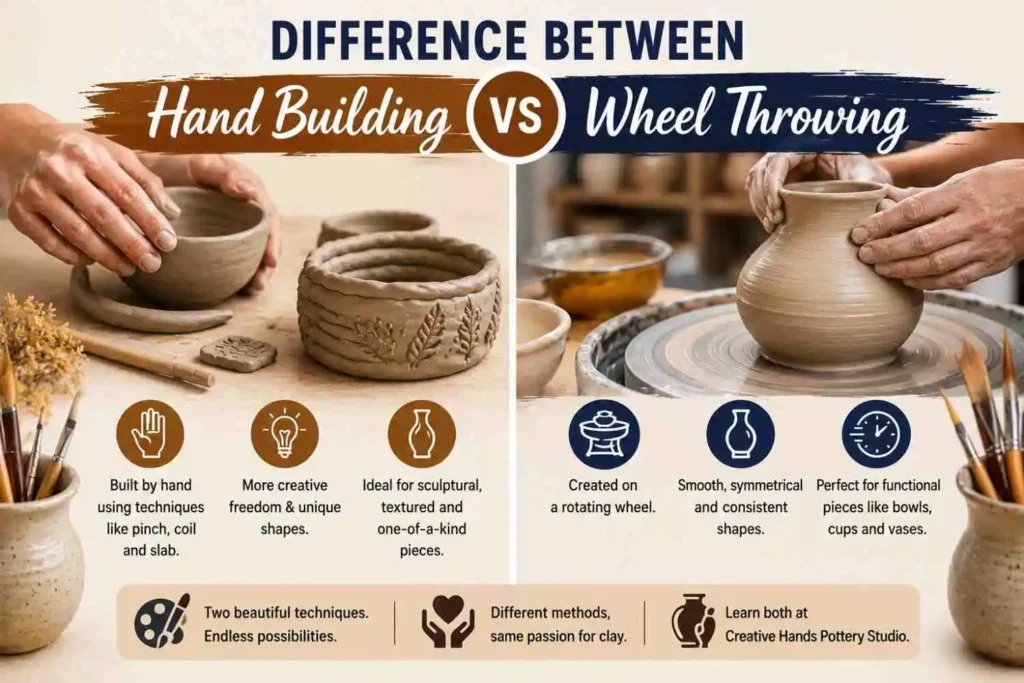
What Is Hand Building In Pottery?
Hand building is a pottery making method that requires shaping clay using your hand, using no pottery wheel. Hand building is among the most accessible forms of pottery, which makes it an ideal alternative for novices and experienced artists as well. Hand-building gives potters the creativity to design distinct shapes, textures as well as designs that might be impossible to create using the wheel.
There are many hand-building methods employed in pottery. These include:-
Pinch Pot Method: Making clay by pinching it to form a shape using your fingers.
Slab Construction: Forming pieces using smooth sheets of clay.
Sculptural Modeling: Hand-shaping clay to create designs or forms that are artistic.
Useful link: Essential pottery tools for every pottery studio
Benefits Of Hand Building
Hand building has numerous benefits that make it an extremely popular technique for pottery for all skill levels. One of the main benefits is that it’s easy for beginners and simple to master. There is not any need to learn how to use a wheel; beginners can concentrate on learning about clay.
Challenges Of Hand Building
Although hand building offers a lot of options for creative expression, it has its own issues. Every piece requires careful cutting and then joining.
Another challenge is the creation of bigger pottery pieces. If clay segments aren’t well joined or supported, they could crack or break in the course of drying and firing. A careful making technique and perseverance are essential to make strong hand built pottery.
What Is Wheel Throwing In Pottery
It is a clay-making technique for creating pottery using a spinning wheel. When the wheel turns and the clay is thrown, the artist uses his fingertips and hands to shape and center the clay into different ceramic pieces. This technique is renowned for producing even, smooth, and symmetrical ceramics, and is one of the most well-known techniques used in ceramics.
Wheel throwing is often utilized to produce a wide range of useful pottery objects that include:
- Bowls
- Cups
- Plates
- Vases
- Containers and pots
Wheel throwing is difficult for novices. It becomes much easier as you practice. Controlling the spin of clay takes concentration, patience, and focus. However, numerous potters find this process satisfying and enjoyable.
Benefits Of Wheel Throwing
Wheel throwing has some benefits, especially when it comes to creating beautiful and functional pottery. One of the biggest advantages is the capability to make extremely symmetrical pieces that have uniform and smooth designs. This is why it’s the ideal choice for making the perfect sets of pottery like bowls, mugs, and plates.
Another advantage is its efficiency. When the fundamental techniques are learned, ceramicists can produce a variety of similar objects faster than using many hand-built methods. Wheel throwing is an extremely popular option for professionals and amateur ceramicists.
Wheel throwing is particularly suited to use in functional pottery as it enables exact shaping and balanced forms. A lot of people enjoy having hands-on experience on a wheel, finding it pleasant.
Key Differences Difference Between Hand Building And Wheel Throwing
Technique And Process
Hand Building
Hand building is entirely dependent on the manual techniques of shaping. The artist uses their hands and basic tools for shaping clay into the desired shapes. It is an easier option for people who are just beginning.
Wheel Throwing
Wheel throwing involves a turning pottery wheel. The clay has to be aligned perfectly before shaping can start and it usually takes a lot of practice and perseverance to learn.
Equipment Required
Hand Building
One of the greatest benefits of handbuilding is the lack of equipment needed. A majority of tasks can be finished with:
- Clay
- Rolling pin
- Wooden tools
- Wire cutter
- Sponge
Wheel Throwing
Wheel throwing is a skill that requires specialized equipment. This includes:
- Pottery wheel
- Bat system
- Trimming equipment
- Water bucket
- Pottery studio setting
Learning Curve
Hand Building
Hand building can be a bit simpler for novices as it lets them learn at their own speed. The mistakes can be rectified without having to start over.
Wheel Throwing
The wheel thrower has a steeper learning curve. Making sure that the clay is centered on the wheel is one of the most difficult skills for beginner potters, and mastering it often requires the guidance of a pottery instructor.
Creative Freedom
Hand Building
Hand-building offers endless creative possibilities. Artists are able to create:
- Organic forms
- Sculptures
- Abstract designs
- Architectural forms
- Decorative art pieces
There are no limits when it comes down to the shape and design.
Wheel Throwing
Wheel throwing can create symmetrical shapes, but it can be restricted for highly abstract or irregular designs.
Advantages Of Hand Building
Handbuilding is still a popular activity for novices and artists for a variety of reasons:
- It is easy to grasp
- A low cost to start
- No expensive equipment required
- Great for artistic and sculptural projects
- For all ages
- Flexible working pace
- Lets you experiment with textures and forms.
This approach is particularly attractive for those seeking the expression of their creativity rather than mass production.
Advantages Of Wheel Throwing
Wheel throwing comes with many advantages of its own:
- It creates highly symmetrical and extremely homogeneous pieces
- More efficient production after mastering
- Perfect for practical pottery
- Elegant and professional appearance
- Great for creating matching sets
- Advanced pottery skill development
Numerous professional ceramic artists as well as pottery studios employ wheel throwing to create commercial collections of pottery.
Which Pottery Technique Is Better For Beginners?
Hand-building is usually the easiest to begin with. It helps students understand clay’s behavior, the control of moisture methods for shaping, as well as basic design principles, without the difficulty of learning control for the wheel.
But those who love the challenge of hands-on work and wish to develop traditional pottery designs might find wheel throwing enjoyable with a bit of practice.
Most pottery instructors suggest doing both methods since each technique develops distinct skills and perspectives.
Final Thoughts
Hand building allows for flexibility and the ability to access information, whereas wheel throwing offers precision as well as symmetry and effectiveness.
If you are interested in creating designs by hand or sculpting beautiful vessels with the pottery wheel. Both methods provide satisfying experiences that can help you build artistic abilities.
Are you ready to begin your pottery journey? You can try hand building as well as wheel throwing to determine what techniques inspire your imagination the most.
Visit our pottery studio in Ras Al Khaimah to experience both hand building and wheel throwing techniques, and discover the joy of creating unique ceramic pieces with expert guidance.
You may also like to read, pottery techniques for beginner students
FAQ
1. Is handbuilding more efficient than throwing on a wheel?
Yes. Handbuilding is usually more accessible for newbies since it doesn’t require any knowledge of the wheel controls.
2. Which type of pottery technique is more suitable for creating artistic designs?
Handbuilding offers more creativity for sculptures.
3. Does wheel throwing speed up more than hand-building?
After mastering wheel throwing, it’s generally quicker to create identical pottery items.
